

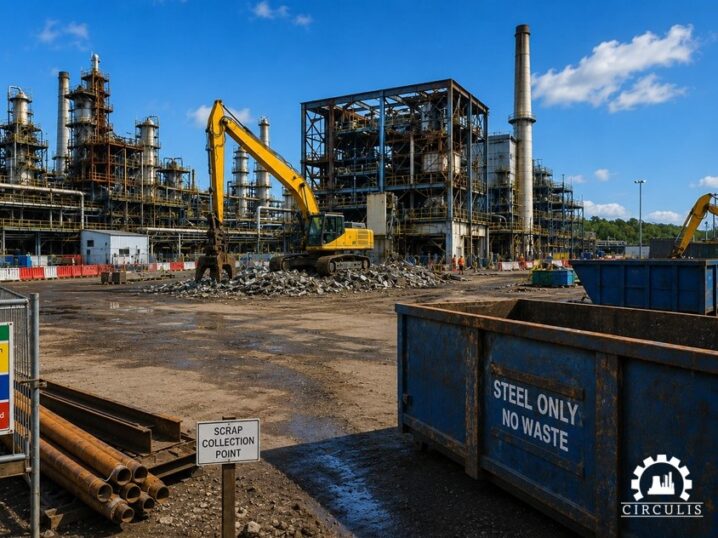
When clients think about the cost of a decommissioning and demolition project, they often focus on the obvious factors:
- asbestos removal
- hazardous materials management
- demolition methodologies
- waste disposal
- temporary works
- environmental remediation
However, one of the largest commercial variables on many industrial decommissioning and demolition projects is often sitting in plain sight.
Scrap metal.
Yet surprisingly few asset owners fully understand:
- how much scrap metal exists within their asset
- what the likely recovery value is
- how scrap assumptions influence contractor pricing
- who should carry the commercial risk associated with scrap recovery
These questions can significantly affect project costs, tender returns, risk allocation and contractor performance.
FEED Is About More Than Risk Reduction
Front-End Engineering Design (FEED) studies are often associated with risk reduction, project planning and engineering assessments.
Clients commonly use FEED to better understand:
- hazardous materials
- structural constraints
- demolition sequencing
- temporary works requirements
- waste management strategies
While these are all critical, FEED can also provide valuable commercial intelligence.
Understanding waste quantities, recycling opportunities, disposal routes and scrap recovery potential can significantly improve the quality of tender information issued to the market.
The result is often improved cost certainty and more informed procurement decisions.
We discussed this topic in more detail in our previous article, FEED for Decommissioning and Demolition, where we explored how Front-End Engineering Design can significantly reduce uncertainty and improve project outcomes before tendering begins.
Why FEED Is Common in Construction but Rare in Demolition
Major construction projects routinely invest significant time and money in FEED studies before construction begins.
Yet decommissioning and demolition projects often proceed with significantly less information despite containing greater uncertainty, hidden conditions and higher levels of risk.
The question clients should ask is:
Why would we spend millions planning how to build an asset but comparatively little planning how to safely dismantle it?
Many industrial demolition projects involve decades of modifications, undocumented changes, ageing infrastructure, hazardous materials, retained assets and live operational interfaces.
Investing time and money during the FEED stage often allows clients to reduce uncertainty before approaching the market, resulting in better tender returns and fewer surprises during project execution.
Understanding What Is Actually On Site
Many industrial facilities contain significant quantities of valuable materials including:
- carbon steel
- stainless steel
- copper cable
- aluminium
- brass
- lead
- electrical equipment
- process plant components
Through site inspections, engineering reviews, drawings, asset records and physical surveys, it is often possible to develop reasonable estimates of:
- steel tonnage
- non-ferrous metal quantities
- cable recovery quantities
- processing requirements
- recycling opportunities
- likely recovery values
This provides clients with a much better understanding of the true value contained within their asset before demolition begins.
Without this analysis, both clients and contractors are often working with assumptions rather than evidence.

Scrap Value Is Only Part of the Story
Whilst scrap recovery can significantly influence project costs, it is only one side of the equation.
Clients also need to understand:
- waste disposal costs
- hazardous waste liabilities
- asbestos waste volumes
- contaminated land risks
- recycling opportunities
- transportation requirements
On many projects, the difference between a profitable outcome and a costly surprise is not simply understanding what materials can be sold, but understanding what materials will cost money to remove and dispose of.
The true commercial picture only becomes clear when both cost and value are understood.
Why Scrap Intelligence Matters During Tender Evaluation
One of the most valuable benefits of understanding scrap quantities is during the tender evaluation process.
Consider a scenario where three demolition contractors submit bids for the same project.
Contractor A estimates 8,000 tonnes of recoverable steel.
Contractor B estimates 12,000 tonnes.
Contractor C estimates 15,000 tonnes.
Without independent analysis, it can be difficult for a client to determine which estimate is realistic.
This matters because scrap recovery often forms a significant part of a contractor's commercial model.
If a contractor has substantially overestimated recoverable scrap value, they may effectively be losing money before the project has even started.
This can create commercial pressure throughout the project and potentially lead to:
- claims and disputes
- programme pressure
- scope challenges
- cost recovery attempts
- reduced project stability
- potential safety performance issues
Conversely, a contractor that significantly underestimates scrap value may appear more expensive during tender evaluation despite offering the most realistic assessment of the project.
Understanding the asset before tendering allows clients to evaluate bids with far greater confidence.
Who Should Carry the Scrap Risk?
On many decommissioning and demolition projects, scrap value risk is allocated directly to the demolition contractor as part of the commercial arrangement.
The contractor estimates the recoverable value of the scrap, incorporates that value into their tender and accepts the risk associated with future market fluctuations.
On the surface, this appears to be a simple solution.
However, the question clients should ask is:
Is this always the best approach?
The Impact of Market Volatility
Today's scrap markets can be highly volatile.
Global demand, energy prices, tariffs, shipping costs, geopolitical events and steel production levels can all influence scrap values.
A project tendered today may not commence for six, twelve or even eighteen months.
By the time scrap is actually recovered, market conditions may look very different.
When contractors are expected to carry all of the scrap market risk, they inevitably price that uncertainty.
This often results in:
- reduced scrap value assumptions
- increased contingency allowances
- higher tender prices
- greater commercial risk premiums
The irony is that the client often pays for much of this uncertainty through increased project costs.
Could the Client Retain the Risk?
An alternative approach is for the client to retain ownership of the scrap and receive the value directly.
This provides several advantages:
- greater transparency
- visibility of actual recovery values
- reduced contractor assumptions
- improved tender comparability
However, it also means the client is exposed to market fluctuations and may require additional administration and oversight.
For some organisations this may be entirely appropriate.
For others it may not align with their commercial objectives.
Is Risk Sharing a Better Solution?
Increasingly, some asset owners are exploring mechanisms that share scrap risk between both parties.
Examples include:
- gainshare and painshare arrangements
- agreed baseline scrap values
- index-linked adjustment mechanisms
- open-book recovery models
These approaches can reduce contractor contingency while still providing incentives to maximise recovery and recycling performance.
More importantly, they help align the interests of both parties rather than creating a situation where one side is effectively speculating on future commodity prices.
There is no single correct solution.
The most appropriate approach will depend on the client's objectives, appetite for risk and understanding of the asset.
There Is No One-Size-Fits-All Solution
There is no universal approach to scrap ownership and risk allocation.
Every decommissioning and demolition project is different.
The most appropriate commercial model will depend on several factors, including:
- the size and complexity of the asset
- estimated scrap value
- market conditions
- programme duration
- client appetite for risk
- contractor capability
- procurement strategy
On some projects, transferring the risk to the demolition contractor may be entirely appropriate.
On others, the client may benefit from retaining ownership of the scrap and receiving the recovery value directly.
In certain circumstances, a shared-risk model may offer the best balance between commercial certainty and exposure to market fluctuations.
The important point is that the decision should be informed by data rather than assumptions.
Understanding likely scrap quantities, recovery values, processing requirements and market exposure allows clients to make informed decisions about the commercial structure that best supports their project objectives.
This is another area where FEED studies and independent Owner's Engineer support can provide significant value.
By understanding the asset before tendering, clients can assess the advantages and disadvantages of different commercial models and select an approach that aligns with their objectives, risk appetite and procurement strategy.
The goal is not simply to allocate risk.
The goal is to allocate risk to the party best placed to manage it.
Why Asset Intelligence Matters
Before deciding who should carry the risk, clients first need to understand what is actually present on site.
This means understanding:
- material types
- estimated tonnages
- metallurgy and material quality
- processing requirements
- recovery rates
- likely market value ranges
- retained assets
- live services
- operational interfaces
Without this information, discussions around scrap ownership and risk allocation are largely based on assumptions.
With it, clients can make informed decisions about procurement strategy, risk allocation and commercial structure.
Turning Information Into Certainty
This is where a robust FEED study and independent Owner's Engineer support can provide significant value.
By understanding:
- hazardous materials
- waste streams
- recycling opportunities
- scrap inventories
- demolition sequencing
- retained assets
- live interfaces
- project constraints
clients can issue higher-quality tender information to the market.
Contractors can then price the project with greater confidence and fewer assumptions.
The result is often:
- improved tender quality
- reduced commercial uncertainty
- greater cost certainty
- more realistic programmes
- safer project delivery
- better overall project outcomes
Information Creates Certainty
The most successful decommissioning and demolition projects are rarely those with the lowest tender price.
They are the projects where the client has invested sufficient time and effort understanding:
- hazardous materials
- waste streams
- retained assets
- demolition constraints
- scrap inventories
- recycling opportunities
- project risks
before approaching the market.
The better the information issued to tenderers, the fewer assumptions contractors are forced to make.
Fewer assumptions typically lead to:
- more accurate pricing
- reduced commercial risk
- improved programme certainty
- safer delivery
- fewer surprises during execution
Whether scrap risk is retained by the client, transferred to the contractor or shared between both parties, the quality of the decision will ultimately depend on the quality of the information available.
Understanding the asset before tendering allows clients to make informed commercial decisions rather than relying on assumptions, contingencies or market speculation.
Ultimately, FEED is not simply about understanding risk.
It is about turning information into certainty.
And in decommissioning and demolition projects, certainty is often one of the most valuable commodities a client can buy.
