


FEED for Decommissioning and Demolition: Why Better Planning Reduces Cost and Risk
When people hear the term Front-End Engineering Design (FEED), they often associate it with the development of new facilities, power stations, refineries or chemical plants.
However, FEED can be equally valuable when planning the retirement of industrial assets.
Many organisations view FEED as an additional project cost. In reality, a well-executed FEED phase can often reduce the overall cost of decommissioning, asbestos removal and demolition projects by removing uncertainty before the project enters the market.
At its core, FEED is about understanding the asset, the hazards, the waste streams, the demolition methodology and the desired end state before contractors are asked to price the works.
The objective is simple:
Remove uncertainty before the market prices the risk.
If FEED is Common in Construction, Why Not in Decommissioning and Demolition?
Front-End Engineering Design (FEED) is widely accepted as a critical stage of major construction projects. Significant time and budget are routinely invested in developing designs, understanding risks, refining scope and improving cost certainty before construction begins.
Yet when it comes to decommissioning, asbestos removal and demolition projects, many organisations still attempt to accelerate programmes by minimising the FEED phase and moving directly into tendering.
This is despite the fact that decommissioning and demolition projects often contain significantly more unknowns than new-build projects.
Ageing assets, undocumented modifications, asbestos and hazardous materials, waste classification, contamination, structural deterioration, live services, ecology constraints and future site requirements all have the potential to significantly influence project cost, programme and delivery methodology.
The result is often predictable. Contractors are forced to make assumptions, add contingency or price uncertainty into their tender submissions.
The question therefore becomes:
If FEED is considered essential when constructing an asset, why would it be any less important when retiring one?
What Does FEED Look Like on a Decommissioning and Demolition Project?
A decommissioning FEED phase typically focuses on developing sufficient understanding of the asset and project objectives before approaching the supply chain.
This may include:
-
-
- Demolition-specific pre-construction information (PCI)
- Asbestos and hazardous materials strategies
- Decommissioning strategies
- Demolition and dismantling methodologies
- Waste management strategies
- Cost estimation
- Programme development
- Risk workshops
- Project execution planning
- Scrap recovery assessments
-
The role of the Owner's Engineer and CDM Principal Designer during this phase is not simply to produce documentation.
It is to challenge assumptions, identify uncertainty, improve project definition and ensure contractors receive clear, relevant and practical information at tender stage.

Why Poorly Defined Projects Cost More
One of the most common mistakes we see is projects entering the market before sufficient planning has been completed.
When scope is unclear, information is incomplete or key risks remain unresolved, contractors are forced to make assumptions.
Those assumptions usually appear in one of two ways.
Either the contractor includes significant contingency within their pricing to protect themselves against unknowns.
Or they underestimate the risks and subsequently face commercial pressure as the project progresses.
Neither outcome benefits the client.
A detailed FEED phase allows many of these uncertainties to be identified, challenged and resolved before the project reaches tender stage.
Waste Strategy: One of the Biggest Opportunities to Reduce Cost
One area where FEED can add considerable value is waste management.
Industrial demolition projects often generate thousands of tonnes of waste across multiple streams, each with different handling, recycling and disposal requirements.
Without detailed analysis, contractors often make broad assumptions regarding waste categorisation, treatment routes and disposal costs.
A FEED phase allows the project team to review waste streams in detail and identify:
-
-
- Recycling opportunities
- Reuse opportunities
- Alternative disposal routes
- Material segregation strategies
- Hazardous and non-hazardous classifications
- Potential cost savings through improved planning
-
This information can then be incorporated into the tender documentation, allowing contractors to price the works against a clearly defined waste strategy rather than relying on assumptions.
The result is often greater consistency across tender submissions and improved commercial certainty for the client.
Understanding Scrap Value Before Tendering
Scrap metal recovery is another area where FEED can significantly influence project outcomes.
Most industrial demolition projects contain substantial quantities of structural steel, pipework, vessels, tanks and other metallic assets.
Understanding what materials are present, their likely tonnage, metallurgy, contamination levels and recovery potential allows clients to develop a far more realistic assessment of the value available within the project.
This information becomes particularly valuable during tender analysis.
On major industrial projects, the difference between contractor assumptions on scrap value can sometimes amount to hundreds of thousands of pounds.
We have seen projects where contractor assumptions regarding recoverable scrap value differed significantly.
If a contractor has substantially overestimated scrap tonnage, recovery rates or future market values, they may effectively be starting the project in a commercially disadvantaged position before work has even begun.
In volatile scrap markets, this can become a significant project risk.
By understanding likely scrap values before tendering, clients are far better positioned to assess contractor submissions, challenge assumptions and identify pricing that may not be commercially sustainable.
Better Hazardous Materials Information Creates Better Outcomes
FEED also provides an opportunity to improve asbestos and hazardous materials information before it reaches the supply chain.
Too often, contractors are issued large volumes of survey information that can be difficult to interpret and navigate.
Additional intrusive investigations, targeted surveys and detailed reviews of existing information can help develop a clearer understanding of the hazards present and how they may affect project delivery.
This reduces uncertainty, improves methodology development and supports more accurate pricing.
The better the information, the greater the likelihood of achieving a safer, more efficient and commercially controlled project.
FEED is an Investment in Certainty
The greatest benefit of FEED is not simply better documentation.
It is better decision-making.
A robust FEED phase helps clients understand:
-
-
- What they are demolishing
- What hazards are present
- What waste streams exist
- What value may be recovered
- What the key cost drivers are
- Where the major project risks sit
- How contractors are likely to approach the works
-
Most importantly, it allows these questions to be answered before the market prices the risk.
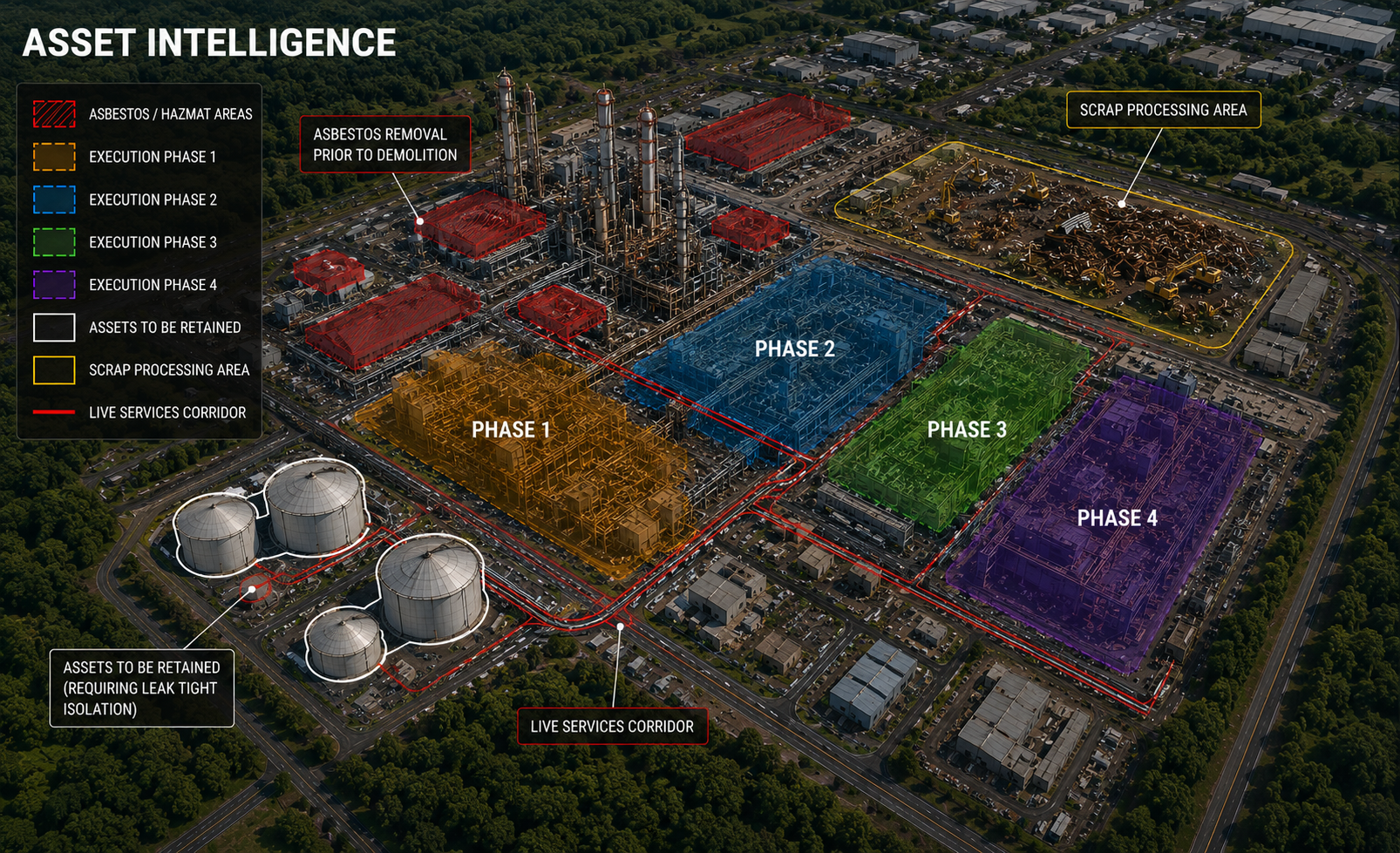
How Circulis Supports FEED for Asset Retirement Projects
At Circulis, we support clients as independent Owner’s Engineer, CDM Principal Designer and demolition subject matter experts throughout the FEED phase of industrial decommissioning and demolition projects.
Our role is to help clients develop robust strategies, reduce uncertainty, challenge assumptions and ensure projects enter the market with the best possible information.
The result is often safer projects, stronger programme certainty, more realistic tender returns and improved commercial outcomes.
Because in decommissioning and demolition, the cheapest place to solve a problem is before it reaches the market.
